Hazy Crazy Days of Summer

I grew up on the Rush Road in Skerries. I remember our first address was 113 Rush Road until the council changed the address to Holmpatrick, some time in the seventies. Michael still refers to our estate as the ‘new estate’ because that’s what the Holmpatrick estate was called when it was being built in the early 70s. Before it became the ‘new estate’ it was known as the ‘Twelve Acre Field’ and originally ‘Dick Derham’s Field’.  I have a very old photograph, taken from the late 1920s or early 30s of my grandfather, Barney Duignan (on my mother’s side) standing beside a pilot in an old light aircraft in the ‘Twelve  Acre Field’. My grandfather was a young police officer in the early days of the Free State and he spent some years as sergeant in Skerries. He married my grandmother, Rita Larkin from Balbriggan in 1935. My mother told me how her mother remembered her and her family hiding in a ditch when Balbriggan was burned by the Black and Tans during the War of Independence in 1920. Little did my grandfather know, that some day into the future, a daughter of his would rear her family around the very spot where he was standing.   
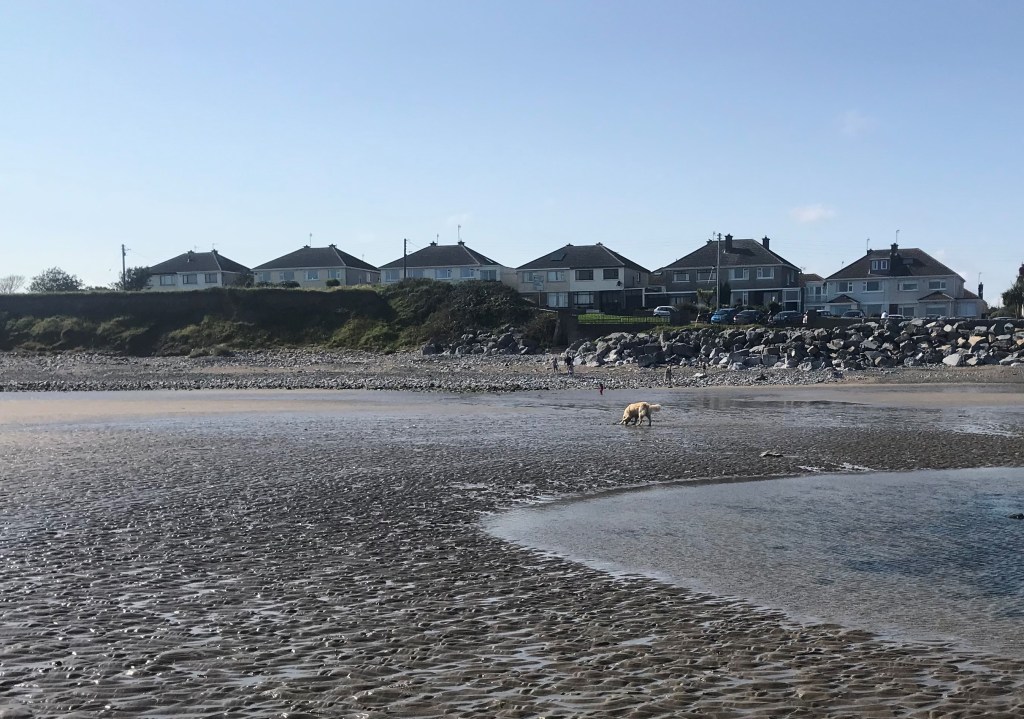
White Wall beach at Holmpatrick

I have great childhood memories growing up on the Rush Road (or the ‘Twelve Acre Field’). Particularly of the Summers where we spent endless hours on the beach across the road. The beach and the cliffs were our playground. We made boats out of sand and sat in them until the tide came in and undid our all our hard work. But that was the fun bit. Or castles decorated with shells and feathers.  The moment just before their demise was always great because the moats we had dug were filled with water and the castles looked amazing. There were mud ball fights and even jellyfish fights (the little purple non stingers). And then there was the pursuit of the perfect mud ball. If you got the darker wetter sand further up the beach at the ‘sinky sand’, for the center of the mud ball and then layered it gradually, topping if off with the light golden sand, you could create the perfect spherical mud ball. As well as aesthetics, the mud ball had to undergo some tests such as surviving being rolled down the sloped bit of the sea wall. It was important that it performed as well as it looked.   My older brother Alan seemed to have the art perfected. (the artist in him I suspect).  

Our father was an expert whistler.  When we heard his whistle it meant it was time for lunch/dinner or just time to come home as it was probably getting late. We would often bury our prize mud balls for safe keeping. We would dig them up later or even the next day and with a bit of touching up they were as good as new.

One time we discovered that the sea had eroded under the concrete sloped part of the White Wall and you could squeeze in underneath.  According to my brother and his friend it was like a giant cave inside. I was too afraid to go in and much to my older brothers’ annoyance I blurted out about it over the dinner table. I could see the look of alarm on my parents’ faces at the thoughts of the wall collapsing on the little boys. The Council were brought in and they duly arrived with their cement to fill it in. It was a bit of a patch job because some years later a large hole appeared in the road in front of the house and you could see the sea water when you looked in. We were even on the 9 o’clock news! A much bigger job was required and the large boulders from the quarry were brought in at that stage along with the new footpath and the steps. I preferred the muddy bank but I was a realist. I didn’t fancy our house falling into the sea.

I also remember the foghorn from the Rockabill lighthouse. The fog could arrive on a very hot day and clear up as swiftly as it arrived. One day I went swimming with my friend and the fog came down suddenly. The tide was half -way out and much to our shock a large seal came up out of the water right beside us, looked at us and gave a loud snort out of his nose. I remember us screaming and running frantically only to find that the water was getting deeper, not shallower.  It took us a while get our bearings and make our way back to the beach in the fog. I still remember the seal and the feeling of panic to this day.  But I really miss the sound of the foghorn.

The cliffs also provided hours of entertainment. One Summer my older brothers and their friends had a gang which they called ‘The Wallys’. (don’t ask- it must have meant something else in the 70s!). At first it wasn’t open to female members but obviously the boys were forward thinking and they allowed a few of us in once we passed certain tests. Myself and two of the girls managed to pass these pretty grueling tests, which was no mean feat. Tests included climbing up a steep part of the cliff and also jumping off and sliding down. There was also the test where you were tied up with ropes that were staked into the ground. You had to escape in a certain time. I think it was a minute. Not everyone passed but once you were in there were benefits to being a Wally! The kudos for one. Also we had influence. Cyril and Clare McGloughlin, our neighbours, owned the delicitessan in Skerries and their kids were proud Wally members too. They kindly provided French baguettes one day when we were having a picnic in our front garden. We had set up a couple of tents for the occasion. It was the first time I had ever eaten or even  seen a French baguette. It was the real deal. It even had poppy seeds on it.

When we got a bit older my siblings along with our friends would venture further afield. We would go to the island and climb the Martello tower. Or we would walk along the beach as far as the waterfall (it wasn’t much of a waterfall really) or to the Devil’s Chair.  Do you know that if you go around the Devil’s Chair three times at midnight the Devil will appear to you? We weren’t brave enough to try that one out. But it’s true. We went to the Smuggler’s Cave of course and I remember squeezing myself through the loop you could do inside. That was scary enough but when I think about the time (on one of our rare trips inland), we walked along the top wall of the tower of Baldungan Castle, I still feel weak at the thought. One wrong move and we were gone. I knew better not to tell my parents about that one at the time. I often wonder how we all survived. Thankfully Baldungan tower is blocked off nowadays.

Often my father would take us out to Shenick Island to catch crabs. He has some gaff hooks and he knows all the crab holes both on Shenick and at Red Island.  I remember him leaping from rock to rock with us following him. He would sometimes put his arm in up to his shoulder to catch a particularly stubborn crab.  The younger kids would be left propped on a rock if the going got tough only to be collected once the bucket was full.  It was very precarious. He only stopped catching crabs a few years ago but my youngest brother and my middle son have inherited ‘the knowledge’ from him!  

His dressed crab is delicious and gives his great friend and neighbour, Cyril, a run for his money with regards his dressed crab recipe.  Sadly Cyril passed not long ago. Cyril was a great supporter of our plans for the Rush Road. Luckily for the people of Skerries Cyril’s son Conor has kept his recipe going.  If you go to the Farmer’s Market at Skerries Mills on a Saturday morning you can buy the best dressed crab in Ireland. (well maybe the second best!!).

There’s no doubt that Rush Road in Skerries was a great place to grow up. We were very lucky and I think we knew it even back then.  My Grandfather Barney went on to become a Chief Superintendent in the Guards. He was an utterly decent and honest man. I miss him very much and I often wish he was here today. I’ve no doubt he would have some good advice to give us……
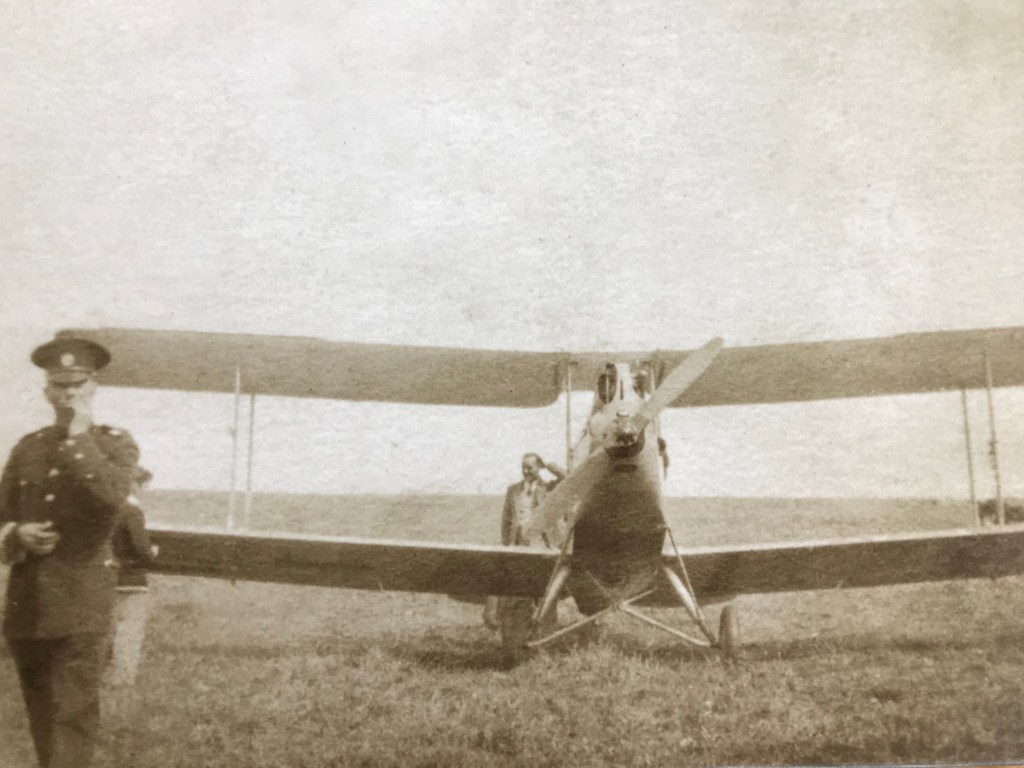
Sergeant Barney Duignan at the Twelve Acre Field c.1930

Propaganda

Every five years the local council votes on a new plan for their area. It is called the County Development Plan.  There is approximately a two year lead up to this process which is known as the Draft Development Plan. At the end of the two year period the local councillors get to vote in the plan that will shape their area over the next 5 years. The public participate in this process by making proposals to their local council and commenting on submissions made by third parties. The executive planners in the council are the administrators of this democratic process.

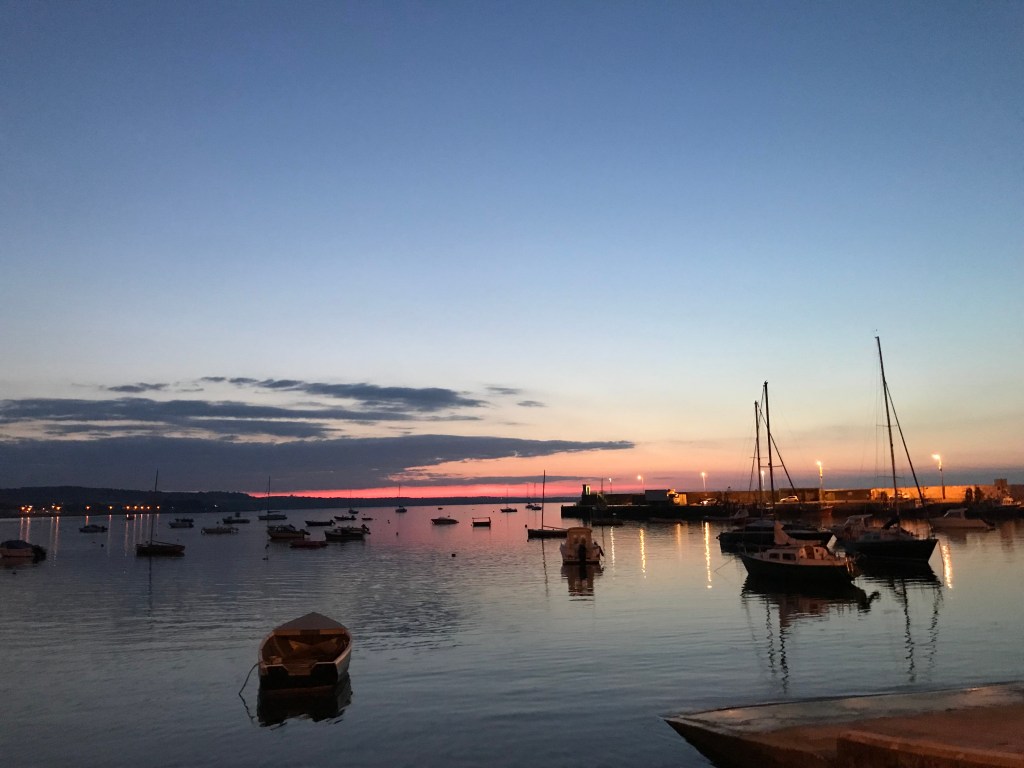
Skerries Harbour

In 2010 we made our submission to the Draft Development Plan process for Holmpatrick Cove. In truth we had made a submission in 2009 but it was returned because it was sent in at the wrong stage of the Development Plan process. (It was site-specific and at that stage they were dealing with strategic plans). The 2009 initial proposal was ambitious. A bit too ambitious as we were talking about Heritage Centres and Bird-Watching platforms and I think even an Aquarium!).  We had been to Lahinch, you see, earlier that year. That’s where the idea for Holmpatrick Cove evolved. They had it all there: hotel, swimming pool, aquarium, Heritage Centre down the road. So, we thought well, why not use our site in Skerries? We knew we had a great site. Strange decisions had been made in the Planning Board around our entrance. We knew they were based on vexatious claims so we could deal with that in the future.

The council had supported our plans for Holmpatrick Cove. By this I mean the executive planners who we went to in the first instance. They were going to propose it themselves in their January 2010 Manager’s Report. But that never happened; there was the famous unexplained U-turn. The local councillors did support our plans so, encouraged by them, we put our submission into the Draft Development Plan in May, 2010. At this point the plan was for a hotel, swimming pool, 24 contemporary houses on the residential lands, a park, training spaces and a coastal walkway- Holmpatrick Cove.

The first commentary on our proposal (Manager’s Report) that came out of the council was in September 2010. Another “Screening Report” followed which went on public display.  The executive had changed their tune, to put it mildly.  Holmpatrick Cove was now “highly undesirable” It was rural, distant, it had no public transport, highly sensitive, highly visible, it would damage the birds on island, it would damage air quality and climate. The report implied that the developers couldn’t be trusted, the entrance was sub-standard, there were plenty of hotels in the area, there was already public paths on the land. If what was said was true, Holmpatrick Cove would have been scandalous. But it wasn’t true. Our proposal was unrecognizable. Only possibly a municipal dump could have elicited such strong objection from the executive planners. The report was aimed at the 24 councillors who were to vote on the proposal in March 2011.

In January of 2011 we had our opportunity to respond to these reports. It was a stage in the Draft Plan that also allowed the public to make their views known. We made our submission dealing with the ‘mis-information’ in the Manager’s and Screening Reports. We included our Court Judgment and Order regarding the entrance and past refusals.  All of the submissions made during that stage were accessible on the Council’s public web-site. Except ours. Our submission was redacted/obliterated. They mustn’t have liked it.

The council executives got to reply to the January submissions in their February Manager’s Report.  “There were a large number of submissions received both in support and opposing Amendments 5.11 and 5.12 (collectively addressed as Holmpatrick).” That’s what they said, the Executive in Fingal Co Co. They were referring to Holmpatrick Cove. The truth is there were 19 against Holmpatrick Cove (including a round robin) and 125 in support (including all of the main sports clubs and societies in the town). The bias shown in the opening statement continued throughout the report.  Previous errors we had drawn their attention to were repeated. Holmpatrick Cove was stilll “highly undesirable” for the same five reasons. (they mustn’t have read the Court Judgment because they still mentioned the substandard access and previous refusals). They must have hidden our reply very well because it was completely ignored. It was now February 2011 and a month before the elected councillors would get to vote on the new County Development Plan

The final Development Plan meeting took place on March 23rd 2011. The councillors came armed with the February 2011 Manager’s Report (they were saving on printing). All 24 councillors were at the meeting and twenty of them spoke. Many of the councillors had bought into it the Manager’s Reports. Why wouldn’t they? There was a motion to take Holmpatrick Cove out of the County Development Plan. The councillor remarked at the meeting in March that she “was struck by the Manager’s lengthy and detailed reply. I haven’t seen such an emphatic reply to an objective”. So, she urged her fellow councillors to support her motion to remove Holmpatrick Cove from the Development Plan.

The executive (Gilbert Power and Rachael Kenny) did their best to defend their reports. Some points were obviously troublesome so there was a bit of clarification done only after the councillors’ debate had concluded. Apparently there were some facts in the Manager’s Reports that they couldn’t defend any more…there is a 33 bus that runs past the site….we haven’t I think anywhere in the report indicated numbers of submissions for or against….In relation to the access onto the road …there were a number of Board Pleanala refusals….we gave the factual panning history…the proposer has won a high court case…and that’s quite correct…and it should be said on the record. There seems to be a suggestion that the proposer has reneged on these lands, in ceding these lands….we were just simply answering the obvious question -were the lands in our control? No.…..In relation to hotels …there is a permission for a hotel at Milverton……you have existing hotels in the area, the Bracken Court Hotel…there are hotels in the area. We did make mention that there were local paths across the site….our information is probably incorrect….In relation to the reduction of Open Space lands where we did say 50%……that was a rough estimation on our part…….You can’t say that it’s visible from all areas of Skerries but it is visible. The senior planners tried their best to undermine Holmpatrick Cove- even at one stage Rachael Kenny displaying an incorrect site plan, the one that had been returned in 2009 with the Heritage Centre and Bird Watching building. This was done to illustrate to the councillors how much land would be taken up by the development. It was misleading to say the least. Perhaps an innocent mistake?

But local democracy won on that occasion. The local councillors defended the proposal and managed to persuade enough councillors to trust that they had their community’s best interest at heart.  The vote went in favour of Holmpatrick Cove. Holmpatrick Cove was on a Statutory footing in the 2011-17 Development Plan.

If anyone was to search the public record to read the official minutes of that meeting they would think the councillors who voted for Holmpatrick Cove must have been on some pretty strong substances to have voted the way they did. The public record consists of a Manager’s Report and a record of the way the vote went. But here’s the shocking bit.  When the minutes were published a month later the heading on the minutes said “The following report by the Manager, which had been considered, was CONSIDERED” (to you and I that means that the following report is the one that was debated).  But it wasn’t the report that had been ‘considered’. The report that was debated was substituted by a new, altered even more negative report. For example there were now 11 numbered reasons why Holmpatrick Cove was “highly undesirable.”  The public record is false.   

At the time we asked them why they altered the minutes and got a non-response. Earlier this year we contacted the council again. We provided detail and wanted the public record amended. The official response was “ The Planning History is on the Public Record”. No it’s not.

It is now 2020 and we are mid-way through the 2017-23 Development Plan. Holmpatrick Cove fell between two Development Plans. The council did grant planning permission for Holmpatrick Cove but it was refused by the planning board in 2017. That decision is a re-play of 2010/11.(For example they ignored the Court Judgment and preferred to mention the past refusals due to the substandard entrance etc. etc.). Also, the Statutory Objectives were taken away and exchanged by a ‘Non-Statutory’ Masterplan by the Fingal executive just before the refusal. Oh dear! That didn’t help. But fear not they did leave in one of the three Statutory Objectives- the one about ceding lands to Fingal. Anyway that’s another story and I’m sure there were at least 19 happy people (including the round robin!). Well maybe at least 21. (Must not forget those in the long grass).

The truth is the 2010/11 reports were biased, there were false and exaggerated statements made to further an agenda.  One-sided information was disseminated in a deliberate manner to influence public opinion.  Facts were manipulated and half-truths were presented as fact. The flow of information was controlled and information was withheld from the public. Loaded language was used to produce an emotional rather than a rational response. This is what the senior executives in the council presided over in 2011. Oh! and by the way, I have just outlined the definition of Propaganda.

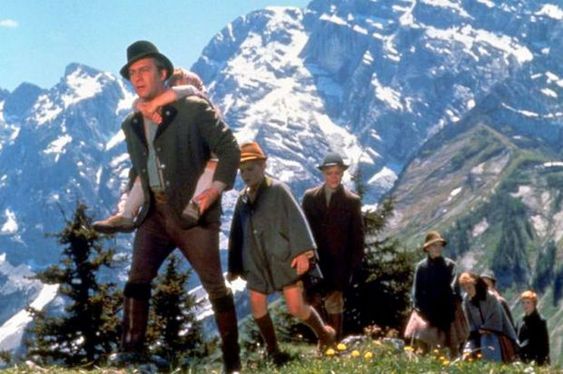
Two nights ago we went to the Lighthouse Cinema to see The Sound of Music. Our eldest son had bought us all tickets. (He studies film and this was special because it was a 4k restoration of the original film). What a movie! Our youngest had never seen it before which I found hard to believe. Our eldest joked afterwards about the parallels in the end scene when the Von Trapp family are walking over the mountains into Switzerland, leaving everything behind them. They all agreed that they were looking forward to the day that we do the same with the field!


Credit: The Sound of Music- Von Trapp family flee to Switzerland

“Sounds Like a Lot of Crap to Me”

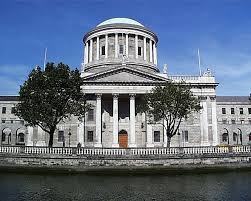
It was December 2010 and we were sitting in the Circuit Court at the Four Courts listening to the opposite side’s expert witness give evidence about the boundary. This surveyor was giving a lengthy description about how boundaries can be marked up. He said that often in the past he could use a scrap of paper to mark out a boundary. He recalled being in a pub and going into the toilet to get some of the old- style toilet paper (the one like tracing paper) and using it to agree a boundary. I will never forget it. Justice Joseph Matthews’ removed his glasses and addressed the court. “Sounds like a lot of crap to me”.  It was the one occasion, over the three-day trial, that the tension was broken in the courtroom and there was loud outburst of nervous laughter. I suspect it was only our side and a few independent observers that saw the funny side, but it was funny. Justice Matthews was a wise, soft spoken judge and his remark stood out in such a sombre setting. There was a lot at stake.

Image: https://archiseek.com/2010/1802-the-four-courts-inns-quay-dublin/

We were in court because of a good old-fashioned boundary dispute. Six of the neighbours to the north had suddenly decided that they owned half our entrance after almost twenty years living there.  They were relying on an old Land Registry map that had “a bit of a dip in it”. This was around the time the Holmpatrick Cove proposal had been submitted into the council when they were doing up their new County Development Plan. If it turned out that they did own half the entrance, well then we would have been goosed. Our surveyor had given evidence before hand. He explained very carefully how boundary lines on the map are “not conclusive” evidence of ownership. He explained how much of these boundary lines were drawn up in India using satellite imagery and using the features on the ground as a reference. He had carried out a “Ground Truth Survey” on our behalf and he went into great detail about how this is the most accurate and equitable method of determining boundaries. He said if we all relied only on the lines on the maps we would have people hopping over walls, hedges, over ditches claiming land the far side of well-established boundaries. (Believe me he’s was right. When you own a field they come at you from all angles).

So, Justice Matthews didn’t appear to be buying the less compelling evidence about the toilet paper. When I think about that toilet paper it brings me right back to my days in the Holy Faith Convent in Skerries. That was the standard toilet paper in the early days of the old convent. It even had ceramic dispensers on the wall where the box was inserted for ease of access. It was not very practical to say the least but sometimes we used it in art class to trace with (not surveys granted) but it was more use there than in the school toilets,

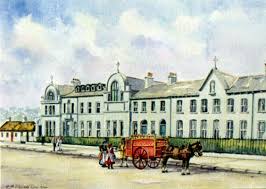
If I close my eyes I can bring myself back to that old convent building. I can walk around and I remember every room. It was an imposing building. I remember the old gym hall with the parquet flooring and the large sash windows. We would sit on the old green mats and deconstruct the old rubber beneath the mats. (They got very shabby in the end). I remember the green terrazzo floors in the bathrooms and the locker rooms. I remember the beautifully carved stair-cases. The high ceilings. I remember the corridor with the statue of the Virgin Mary at the end. Sr Imelda’s shop was on the right-hand side going down and the junior and senior infants classes were on the left. At break time Sr Imelda would drag open the concertina shutter. We would all be pressed up against it to get our hands on a Big Time Bar or maybe even a Caffrey’s Snowball. She was a force to be reckoned with, Sr Imelda. She would shout at us all to stand back and God forbid if she caught you running up and down the corridor.

One of my favourite memories was when we were brought up in single file to go to the little chapel. I loved it as much for the journey as the destination. We were now entering ‘Nun Only’ territory as we had to go through the Nun’s area to get upstairs. I loved the view from the corridor upstairs. You could see the two windmills and right up to the back of Dr Healy’s house and the house beside it with the sun-room on an upper floor. It was magical.

The chapel itself was an awesome space. Not that I gave much time to prayer, but I did love the architecture: the beautiful stained-glass window, the high ceilings and the wood carvings. Outside the building I also remember the orchard with the apple trees. There was a little farm and I remember Mr Coleman showing us the hedgehog. There was an ornamental fishpond and a large concrete yard where we played skipping with a big rope. As we got older we moved out to the prefabs in the field. It wasn’t quite the same as being in the main building.

My grandfather had been brought up by the Nuns in this convent. His father died putting decorations on a Christmas tree in 1903. He fell off the ladder. His mother died of ‘a broken heart’ a year later, leaving three orphans: my grandfather aged three and his two older sisters. His father and his two brothers had come up from Tipperary some years before and the three brothers bought a pub each between Drumcondra and Dorset Street. My grandfather’s one is the one with the man and the clock at the top of Dorset Street. It was once called Ryan and Son (my grandfather). The three orphans were left in the care of the Holy Faith Nuns in Skerries where we believe they were well cared for. However, as in most good Irish stories, by the time my grandfather reached 18, his inheritance had been spent by the executors- probably at the bar in the three pubs! In any case at that time he was in the Dublin Fusileers and fighting in the battle of the Somme. He was lucky. He survived his gun-shot wound. By the time the Second World War came along he moved back out to Skerries with my Grandmother and their young children because he was afraid Dublin would be bombed.

My grandmother, Mrs Ryan, taught French and Irish (and even Spanish after school) for many years in the convent. She retired just before I started school. My grandfather’s first cousin, Sr Alophonsus, lived there. She didn’t teach and I’m not quite sure what her role was but I suspect it was in the kitchen due to her large girth. She had a very sweet tooth and I often benefited to the tune of a packet of Toffo or a Caramel bar that she would root out of the pockets in her robes. I was always happy to run into her.

Back to our run-in in the courts. Michael told our story in court. It was easy to tell. It was the truth. The opposite side’s evidence (delivered by the objector in chief to our planning) was described in the written Court Judgment as “wholly incredible”. It was fantasy: “always knew I owned the land the far side of the hedge but it never occurred to me to mention it” in my voluminous objections, “the hole cut in the hedge for us to enter was always there” (you just couldn’t see it) etc. etc.  We won our case. In fact, we made a bit of national history when Justice Matthews ordered that the boundary between us and the six neighbours was to be registered by GPS co-ordinates in the Property Registration Authority. This was a first in Ireland. We now had conclusive evidence that our entrance was not “substandard in width”. We knew this of course. It had been accurately reflected in our planning documents. It was 11.5 meters and the Court Order ruled that our sightlines could not be blocked. The neighbours had to remove the fence they erected in our laneway and put it all back to the way it was.

In the months leading up to the court case there had been a tirade of legal letters and much wasting of police time.  The neighbours would plant the laurels and we would remove them and give them to the police. They would complain to the police of theft only to find that the police had the laurels in the back yard. It was nonsense. I witnessed them planting them one day. They were being advised by the friend across the road and there was great laughter.  They were checking to make sure they blocked the view of the road from our entrance – our sightlines. They didn’t notice me approaching and observing what was going on.

After the court case I got a phone from a dog walker intervening on behalf of one of the families in the court case.  Costs had been awarded against the six parties and the dog walker was wondering if I would do something for them. “Isn’t it unfortunate when families fall out”. Ironically, I found their planning records (the opposite side’s) a few months later. There it was in black and white (or in fact magenta and black as it was on an old microfiche). Our entrance was clearly marked out on their own architectural drawings measuring 12-meters. They should have brought these documents along to court and we all could have avoided costs let alone stress and falling out. Justice Matthews was right. It was all “a lot of crap”.

We sent the Court Judgment and the Court Order to the Planning Appeals Board in 2017 when Holmpatrick Cove was under appeal. We were half expecting an apology because the three previous refusals were all based on the so called “substandard entrance in terms of width” and the resulting traffic hazard. It was the first time we were at the Planning Board since our court case. Funny thing was they didn’t pay any attention. In fact the inspector, in his assessment of the entrance, made no reference to the Court case and preferred to refer to the previous refusals where planning was refused because the entrance was “substandard in width”. The Court Case was an inconvenient truth.

As regards the Holy Faith Convent building. It was knocked down in the 1980s. I lived in one of the homes built where the old convent was. It was a lovely home. But it’s an awful shame that the old convent building was lost.

Holy Faith Convent Skerries – Hugh FitzGerald Ryan

Those Who Walked the Land

About seven months ago (or maybe longer) I was lying awake at about three am. My mind was racing.  It was a time when we had a bit more hope about keeping our planning alive because we were, or so we thought, about to sign a deal with another funder which would allow us to move forward and go back in for planning. Most importantly we would get our home and the land around it, out of the security. However, just like numerous other deals that came before that, they pulled out at the eleventh hour because a planner advised them to. (That happened a few weeks before Christmas). 

I couldn’t get back to sleep that night and didn’t want to wake Michael up because unusually he wasn’t awake and to be honest, it is a rare occasion that we get a full night sleep. So, I decided I would make myself a cup of tea and go out and sit on the deck for a bit. It was a cold night and I was wrapped up in a big blanket.  The tide was fully in and I could hear the sea. It wasn’t roaring as it sometimes does when it funnels in between Lambay and Shenick Island.  It was a gentle lapping sound. It was pitch black too but I was conscious of what was out there…. the islands and the Rockabill lighthouse beyond. 

I grew up looking out at Shenick Island. Of all the islands it is my favourite. It’s the boss. It’s monumental. The other islands seem to fall in line behind it. Now, a modern-day planner might take issue with the Martello Tower, describing it as “Visually Intrusive’. They probably would have refused planning permission. But I like it. I missed Shenick when I lived away from it and I don’t know how many times a day I look out at it. Depending on the tides, the light and the time of day, the view is never the same. I never tire of it.

It was really peaceful out on the deck in the darkness. I was thinking about the land of course but for a change I was thinking about the people that lived there long, long before we ever walked this earth. We had done an archaeological study as part of our planning and I was fascinated to learn that we had a Iron Age Industrial site on our land. I was thinking about the glamping we were hoping to do in front of the house and how it would be great to echo the Iron Age villages in our design. I was wondering about these people, what they looked like, how they lived. They would have lived a very tough existence.

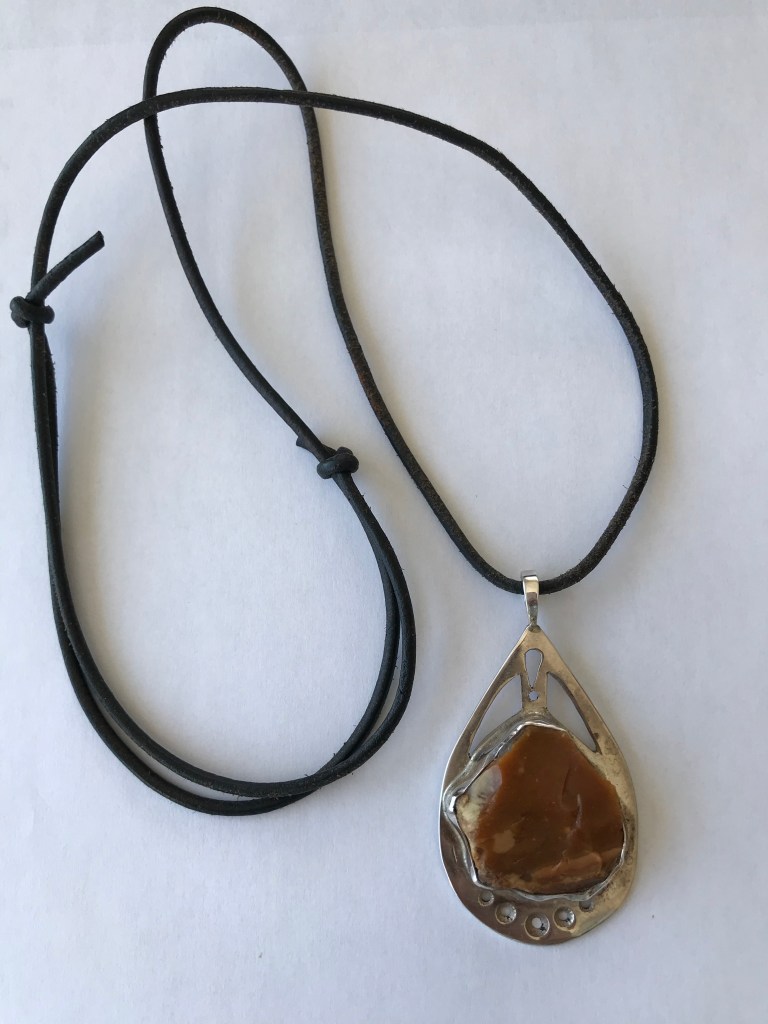
As part of the archaeological study a series of test trenches were dug. The test trenches and the imaging unearthed a circular ceremonial type enclosure on the upper field and some fire pit remains. On the lower field there are remains of a large rectangular Fulacht  Fiadh – a large pit that was lined with stones, filled with water and heated by hot stones. I’m not a historian so I’m open to correction, but it was explained to us that this would have been used for dying skins and cooking food. The archaeologist explained that, just as you wouldn’t want to live in an industrial site today, the Iron Age people’s homes were probably located on the flatter ground where I grew up and where the Holmpatrick Estate is today. (better not mention the National Planning Framework’s plans for Industrial Estates so!). He gave me a lovely flint scraper (the archaeologist). I love flint. Michael got our friend Ed Cook to make it into a necklace for my birthday. I love the necklace. It’s my lucky flint!!

Flint Scraper by Edward Cook- Wayland’s Forge

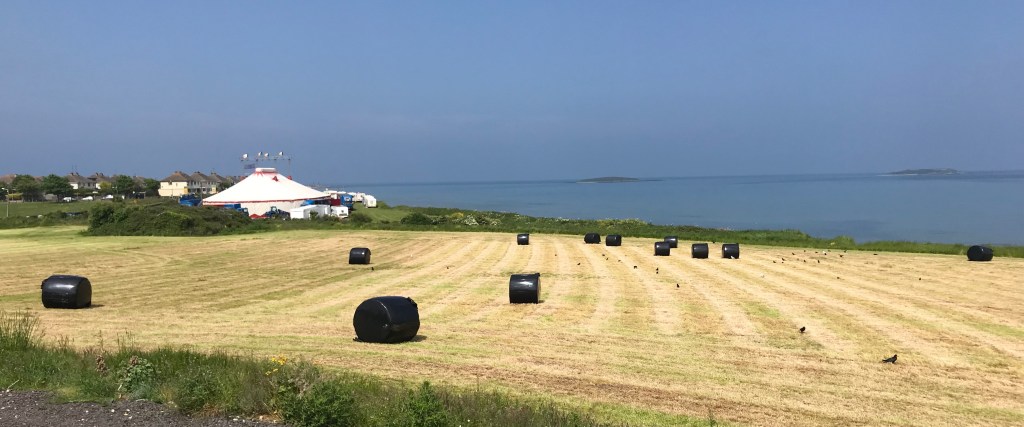
I once thought I might study archaeology just as my uncle and grand uncle had done before. During the heatwave in 2018 there were great archaeological discoveries made thanks to the dryness of the earth. I thought I would have a go at it myself. I discovered a circular shape just beside our field in the Nun’s Field and I was very excited by it. I showed the Google Earth Image to my father and he said two words; Fosset’s Circus!  We got a good laugh out of that. Of course, that was where the circus tent goes every year. I think I should leave the archaeology to the experts. 

So back to sitting on the deck in the dark. It got me thinking about how insignificant everything we were going through is in the greater scheme of things. That we are only really borrowing the land. (Mind you at that time I thought it would be for a bit longer!)  But I felt close to those souls that came before us. It was very peaceful and I slept well afterwards.  

Hanging and Other Fish

Once I went up to the field. It was sometime in 2010, before our court case. (I will go into the court case another time if only for its comedic value). I went up to check the entrance because strange things were going on up there. A new fence arrived in the middle of our entrance courtesy of six of the neighbours that lived the far side of the hedge. (After two decades living there, they had suddenly decided that they owned half of our entrance). Very strange, especially as we had all bought our land from the same lady: the lady of the poker game. Also, furious planting of giant laurel hedging was going on at their entrance and magically a giant hole appeared further down the hedge (another story too).

undefined

So, when I arrived up I saw a plastic bag placed hanging on the hedge inside the newly erected fence. I had to climb over the new fence to retrieve it.  It was a bag full of dead fish. Now, if I lived in Chicago in the 1930s I would have been very worried. Something along the lines of …if you don’t stop what you’re doing, death was at your door……you will sleep with the fishes…..you’ll be swimming with the fishes. Lovely. But this was 21st Century Skerries.

I binned it of course. I don’t like litter. 

It’s not the only time something sinister happened. A councillor told us that he was approached by a little fish in the council headquarters. This little fish is someone who tells everyone he has an awful lot of money in the bank (last I heard there was 2m ). What was said to the councillor and referring to my husband Michael, “one of these days someone is going to take that fella out”. Lovely. 

So back to fish. We know there are very big fish who have influenced our planning. We are only small fish and as a local councillor told us (after our planning was refused by the big fish in An Bord Pleanála), that the council had “bigger fish to fry” and therefore couldn’t intervene with regards our situation. Something to do with a new National Planning Framework and the M50 restriction that was causing the council a bit of bother……

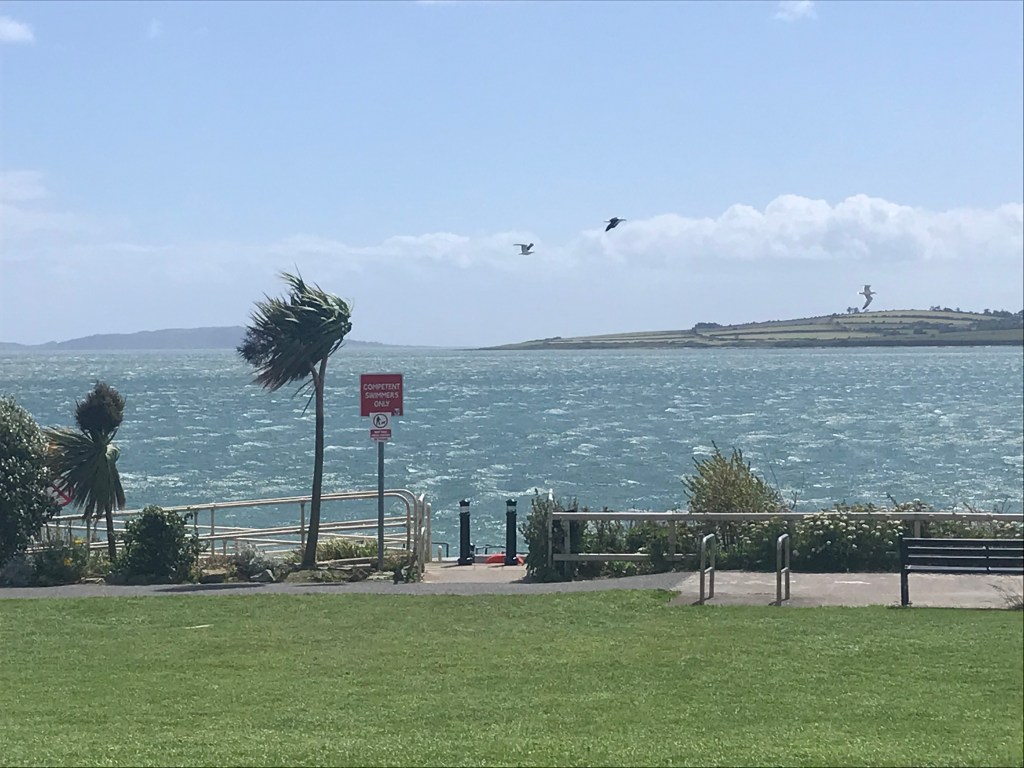
Enough about all of that and speaking of fish I think I will go for a swim to the Springboards later, it’s not a bad day in Skerries and from where I’m sitting (for the moment) the sea looks nice. It’s good to be alive. 

The Springers today